VWAP is one of the most widely used price benchmarks in financial markets. While it may look like a simple indicator, VWAP plays a critical role in how institutional traders measure execution quality, manage large orders, and assess fair value during a trading session.
Understanding VWAP helps investors better interpret price behavior in both stock and crypto markets.
What Is VWAP?
VWAP stands for Volume Weighted Average Price.
It represents the average price of an asset, weighted by trading volume, over a specific period — usually a single trading session.
In simple terms, VWAP answers the question:
At what price did most trading activity actually occur today?
How VWAP Is Calculated
VWAP is calculated by:
- Multiplying price by volume for each trade
- Summing those values
- Dividing by total traded volume
Because volume is included, VWAP reflects where meaningful participation happened, not just price movement.
Why Institutions Track VWAP
VWAP is especially important for institutional participants who trade large sizes.
Institutions use VWAP to:
- Measure execution quality
- Minimize market impact
- Avoid signaling large orders
- Benchmark trading performance
Buying below VWAP or selling above VWAP is often considered favorable execution.
VWAP as a Fair Value Reference
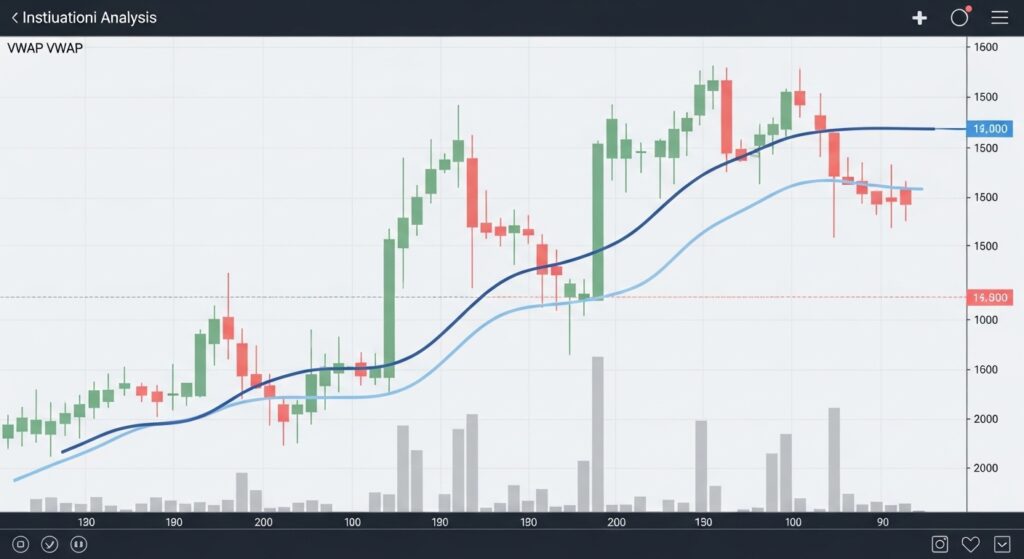
VWAP often acts as a dynamic fair value level during a session.
- Price above VWAP may indicate bullish intraday sentiment
- Price below VWAP may signal bearish pressure
- Repeated interaction with VWAP can suggest balance or indecision
For this reason, VWAP is closely monitored throughout the trading day.
VWAP in Stocks vs Crypto
VWAP applies to both markets, but behavior differs.
Stocks:
- Clear session boundaries
- VWAP resets daily
- Strong institutional relevance
Crypto:
- 24/7 trading complicates session definitions
- VWAP is often applied to custom time windows
- Used more as a trend and mean reference
Despite structural differences, VWAP remains a useful anchor in both markets.
How Traders Use VWAP
Traders often use VWAP to:
- Identify intraday bias
- Time entries and exits
- Avoid chasing extended prices
- Manage risk relative to fair value
VWAP is commonly combined with volume profile, market structure, and liquidity analysis.
Limitations of VWAP
VWAP is not predictive. It:
- Does not forecast direction
- Lags real-time price movement
- Works best during active trading periods
Relying on VWAP alone can lead to false signals in low-volume or highly volatile conditions.
VWAP and Market Behavior
VWAP reflects collective trading behavior rather than opinion. It shows where capital was committed, making it a powerful contextual tool rather than a standalone signal.
For investors in stocks and crypto, VWAP offers insight into how professional participants view price — and where fair value may lie during a session.
VWAP as a Professional Benchmark
VWAP is not just an indicator — it is a benchmark used by institutions to evaluate execution and manage risk. Understanding VWAP helps individual investors align analysis with how larger market participants operate.