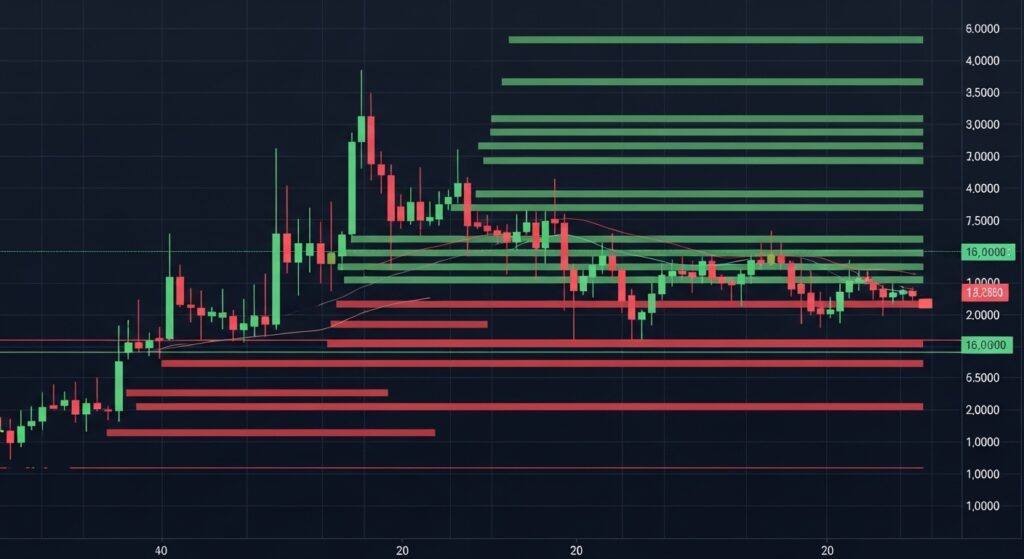
Volume Profile is a market analysis tool that shows where trading activity actually occurred, not just when it happened. Unlike traditional volume indicators that track activity over time, Volume Profile maps volume across price levels, revealing where the market has accepted or rejected price.
Understanding Volume Profile helps investors identify key zones of interest in both stock and crypto markets.
What Is Volume Profile?
Volume Profile displays the distribution of traded volume at each price level over a selected period.
Instead of asking “How much traded today?”, Volume Profile asks:
- At which prices did the most trading occur?
- Where did buyers and sellers agree on value?
- Which price areas attracted little interest?
This makes it a powerful tool for understanding market behavior.
Key Components of Volume Profile
Volume Profile is built around several core concepts:
Point of Control (POC)
The price level where the highest volume was traded.
It often represents the market’s strongest consensus of fair value.
Value Area
The price range that contains a large percentage of total volume, typically around 70%.
This zone reflects where the market spent most of its time accepting price.
High Volume Nodes (HVN)
Price levels with heavy trading activity.
These areas often act as support or resistance.
Low Volume Nodes (LVN)
Price levels with minimal trading.
Markets tend to move quickly through these zones.
Why Volume Profile Matters
Volume Profile helps explain:
- Why price stalls or reverses at certain levels
- Where strong support or resistance may form
- Why some breakouts fail while others accelerate
Unlike simple indicators, Volume Profile highlights where market participants actually committed capital.
Volume Profile and Price Discovery
Volume Profile complements price discovery by showing:
- Where price was accepted
- Where price was rejected
- How value shifted over time
Markets often rotate between high-volume areas before breaking into new value zones.
Volume Profile in Stocks vs Crypto
The concept applies to all markets, but behavior differs.
Stocks:
- Clear session boundaries
- Strong institutional volume
- Stable value areas around earnings and macro events
Crypto:
- Continuous 24/7 trading
- Faster value shifts
- More frequent transitions between volume zones
Despite these differences, Volume Profile remains effective in both environments.
How Traders Use Volume Profile
Investors and traders use Volume Profile to:
- Identify high-probability entry and exit zones
- Manage risk around value boundaries
- Avoid trading in low-liquidity price areas
- Align trades with institutional activity
It provides context that traditional charts often miss.
Limitations of Volume Profile
Volume Profile is not predictive on its own. It:
- Does not indicate timing
- Cannot forecast direction
- Must be combined with structure, liquidity, and sentiment
Used correctly, it enhances decision-making rather than replacing analysis.
Volume Profile as a Market Map
Volume Profile acts as a map of market participation. It shows where interest was concentrated and where it was absent — information that is critical for understanding price behavior.
For investors in stocks and crypto, Volume Profile offers a deeper view into how markets form value and react around key price levels.