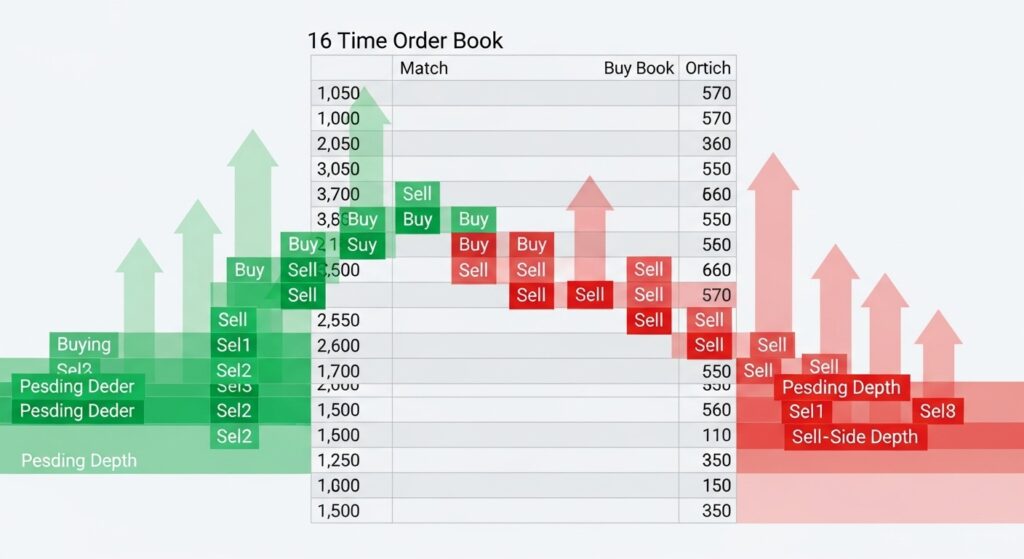
Order flow describes how buying and selling activity actually moves prices. While charts show past price action, order flow focuses on real-time pressure from market participants — revealing who is in control and how aggressively they are acting.
Understanding order flow helps investors interpret price movement more accurately in both stock and crypto markets.
What Is Order Flow?
Order flow refers to the stream of buy and sell orders entering the market and how those orders interact with available liquidity.
At its core, order flow answers three key questions:
- Who is buying and who is selling?
- How aggressively are they trading?
- Is liquidity absorbing orders or being overwhelmed?
Price moves when order flow becomes imbalanced.
Buying Pressure vs Selling Pressure
Order flow reflects the balance between two forces:
Buying Pressure
Occurs when buyers are willing to:
- Pay higher prices
- Execute market orders
- Absorb available sell liquidity
Sustained buying pressure pushes prices upward.
Selling Pressure
Occurs when sellers:
- Accept lower prices
- Hit bids aggressively
- Overwhelm available demand
Sustained selling pressure drives prices lower.
Price movement is the result of which side is more aggressive, not which side has more participants.
How Order Flow Moves Price
Prices move when incoming orders exceed available liquidity at current levels.
- If buy orders consume sell orders faster than new supply appears, price rises
- If sell orders consume buy orders faster than demand replenishes, price falls
This interaction happens continuously, trade by trade.
Order Flow vs Volume
While related, order flow and volume are not the same.
- Volume shows how much traded
- Order flow shows how it traded
High volume with balanced order flow may result in consolidation, while aggressive order flow can move price even on moderate volume.
Order Flow in Stocks vs Crypto
Order flow mechanics apply to all markets, but structure matters.
Stocks:
- Centralized exchanges
- Institutional market makers
- Defined trading sessions
- More stable liquidity
Crypto:
- Fragmented exchanges
- 24/7 trading
- Higher retail participation
- Faster sentiment shifts
As a result, crypto prices often respond more sharply to order flow imbalances.
Tools Used to Analyze Order Flow
Traders analyze order flow using:
- Time and sales data
- Order book changes
- Market orders vs limit orders
- Volume delta
- Aggressive vs passive trade analysis
These tools help identify who is driving price movement.
Why Order Flow Matters
Order flow explains:
- Why breakouts succeed or fail
- Why support or resistance breaks suddenly
- Why price moves without obvious news
- Why indicators sometimes lag real movement
It provides insight into market intent, not just market outcome.
Limitations of Order Flow
Order flow analysis:
- Requires context and experience
- Can be noisy in low-liquidity conditions
- Does not predict future news
- Works best alongside structure and risk management
It should be used as a confirmation tool, not a standalone strategy.
Order Flow as the Engine of Markets
Order flow is the engine that drives all price movement. Fundamentals, sentiment, and technical levels matter — but prices move only when orders hit the market.
For investors in both stocks and crypto, understanding order flow provides a deeper view into how and why markets move in real time.