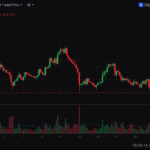
Market structure explains how prices organize themselves over time. While indicators focus on calculations, market structure focuses on price behavior itself — revealing whether a market is trending, consolidating, or transitioning.
Understanding market structure helps investors identify trend direction, avoid false signals, and align decisions with how markets actually move in both stocks and crypto.
What Is Market Structure?
Market structure describes the sequence of price swings formed by highs and lows on a chart.
It answers key questions:
- Is the market trending or ranging?
- Who is in control — buyers or sellers?
- Has the trend changed or continued?
Rather than predicting the future, market structure helps interpret current market conditions.
Higher Highs and Higher Lows
An uptrend is defined by:
- Higher highs — each peak exceeds the previous one
- Higher lows — pullbacks stop above prior lows
This structure shows that buyers are consistently willing to pay higher prices, maintaining upward pressure.
Lower Lows and Lower Highs
A downtrend is defined by:
- Lower lows — each decline breaks previous support
- Lower highs — rallies fail below prior peaks
This structure reflects persistent selling pressure and weakening demand.
Ranges and Transitional Structure
When markets fail to produce clear higher highs or lower lows, they often enter:
- Ranges — price oscillates between defined boundaries
- Transitions — structure shifts before a new trend forms
These phases are critical, as breakouts or breakdowns often follow.
Breaks of Market Structure
A break of structure occurs when price violates a previous high or low that defined the trend.
- In an uptrend, breaking a higher low may signal weakness
- In a downtrend, breaking a lower high may suggest stabilization
Structure breaks do not guarantee reversals, but they often indicate changing conditions.
Market Structure in Stocks vs Crypto
The concept applies universally, but behavior differs.
Stocks:
- Clear session boundaries
- Slower structural changes
- Institutional participation stabilizes trends
Crypto:
- 24/7 trading
- Faster structural shifts
- More frequent false breaks
Despite these differences, market structure remains a reliable framework in both markets.
Why Market Structure Matters
Market structure helps investors:
- Trade with the trend instead of against it
- Identify logical support and resistance
- Improve risk management and timing
- Filter noise from indicators
Structure provides context that indicators alone often miss.
Limitations of Market Structure
Market structure:
- Does not predict exact turning points
- Can be subjective without clear rules
- Works best when combined with volume, liquidity, and order flow
Used correctly, it becomes a framework rather than a signal.
Market Structure as a Market Language
Market structure is the language price uses to communicate intent. Higher highs, lower lows, and range behavior reveal who controls the market at any moment.
For investors in both stocks and crypto, understanding structure builds clarity, discipline, and alignment with market behavior.