Market liquidity is one of the most important — and most misunderstood — concepts in trading and investing. Prices may grab headlines, but liquidity determines how easily those prices can actually be traded. Whether you’re buying stocks or trading crypto, liquidity shapes execution quality, volatility, and risk.
Understanding liquidity helps investors avoid hidden costs, manage risk, and interpret market moves more accurately.
What Is Market Liquidity?
Market liquidity refers to how easily an asset can be bought or sold without causing a significant change in its price.
A liquid market typically has:
- Many buyers and sellers
- High trading volume
- Tight bid–ask spreads
- Fast order execution
An illiquid market, by contrast, has fewer participants, wider spreads, and higher price impact from trades.
Why Liquidity Matters More Than Price
Two assets can trade at the same price but have very different liquidity profiles. The difference shows up when you try to execute a trade.
Liquidity affects:
- Execution cost (slippage)
- Speed of entry and exit
- Volatility during news events
- Risk management and stop-loss behavior
In low-liquidity conditions, even small orders can move prices sharply.
Liquidity in Stock Markets
In equities, liquidity is influenced by:
- Market capitalization
- Average daily volume
- Number of active market makers
- Trading hours and session overlaps
Large-cap stocks typically offer deep liquidity, especially during regular trading hours. Liquidity often drops during:
- Premarket and after-hours sessions
- Holidays or shortened trading days
- Periods of macro uncertainty
This is why price moves outside regular hours can be exaggerated and later reverse when full liquidity returns.
Liquidity in Crypto Markets
Crypto markets add another layer of complexity. Liquidity varies widely across:
- Exchanges
- Trading pairs
- Time zones
Major assets like Bitcoin and Ethereum generally maintain strong liquidity, while smaller tokens may experience sharp liquidity gaps. This can lead to:
- Sudden price spikes or crashes
- Large slippage on market orders
- Increased vulnerability to manipulation
Unlike stocks, crypto trades 24/7 — but liquidity is not evenly distributed across all hours.
Bid–Ask Spread: A Key Liquidity Signal
One of the simplest ways to assess liquidity is the bid–ask spread:
- Tight spread → high liquidity
- Wide spread → low liquidity
Even when prices look stable, a widening spread signals deteriorating market conditions. Professional traders monitor spreads as closely as price charts.
Liquidity vs. Volatility
Liquidity and volatility are closely related but not the same.
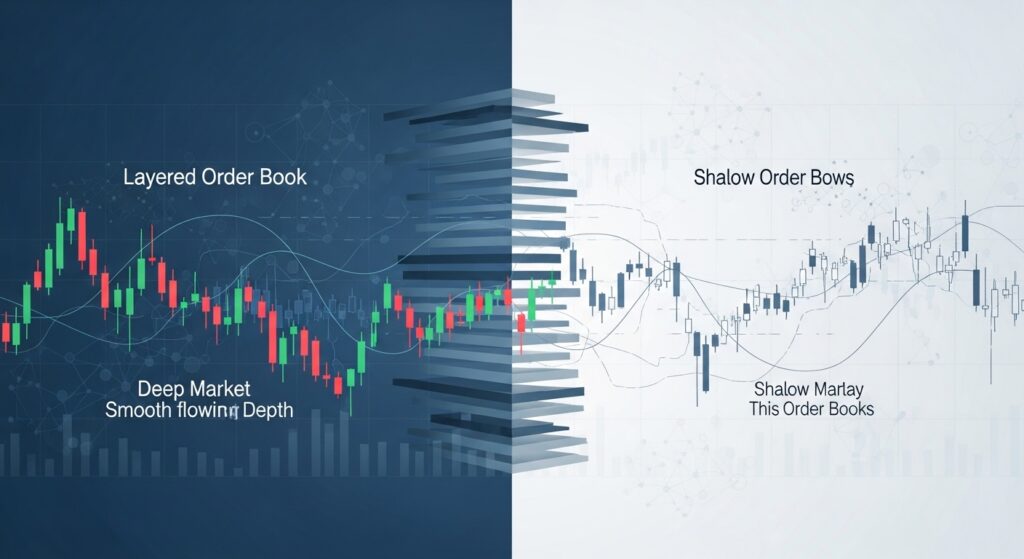
- Low liquidity often amplifies volatility
- High liquidity can absorb large orders with minimal price impact
This is why markets can become unstable during liquidity shocks — for example, during sudden news events, exchange outages, or macro announcements.
How Institutions Think About Liquidity
Institutional investors treat liquidity as a core constraint. Before entering a position, they consider:
- How long it would take to exit
- How much price impact their size would create
- Whether liquidity would vanish during stress
This is one reason institutions favor highly liquid assets and structured execution strategies.
Practical Tips for Retail Investors
To manage liquidity risk:
- Avoid large market orders in thin markets
- Be cautious during off-hours trading
- Watch volume and order book depth
- Use limit orders when liquidity is uncertain
- Don’t assume 24/7 markets mean constant liquidity
Liquidity risk is often invisible — until it isn’t.
Why Liquidity Deserves More Attention
Market liquidity doesn’t trend on social media, but it quietly determines outcomes. It explains why prices overshoot, why stops fail, and why some trades cost more than expected.
In both stocks and crypto, liquidity is the foundation beneath every price move. Ignoring it means trading blind to one of the market’s most powerful forces.
Final Thoughts
Price tells you where the market is.
Liquidity tells you how safely you can act.
For investors navigating increasingly complex markets, understanding liquidity is no longer optional. It’s a core skill — one that separates smooth execution from costly surprises.