Crypto trading is the act of buying and selling cryptocurrencies in order to profit from price movements. Unlike long-term investing, trading focuses on shorter time frames — from minutes to weeks — and relies on market volatility.
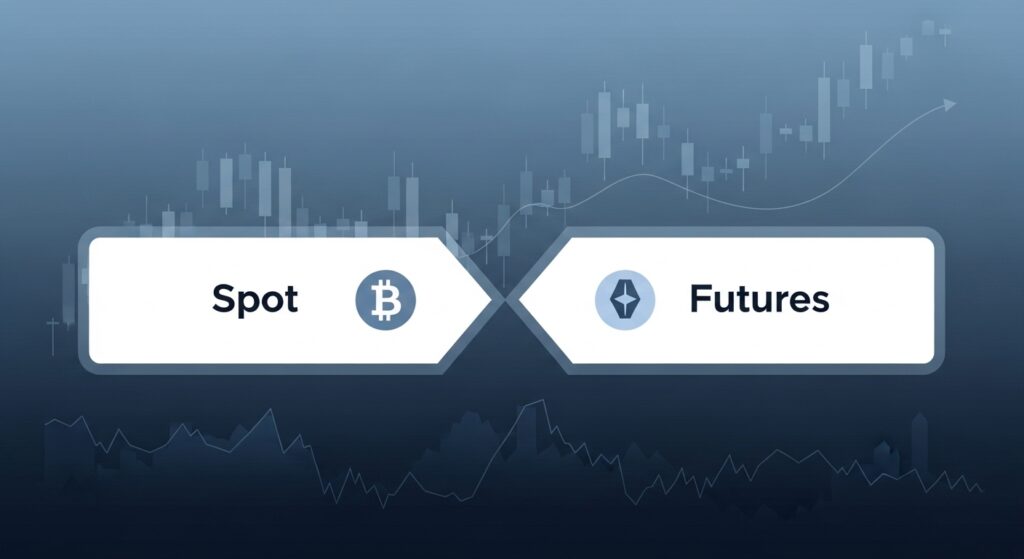
Two of the most popular types of crypto trading are spot trading and futures trading. While they may look similar at first glance, they work very differently and carry very different risks.
This article explains both in simple terms and helps you understand which one fits your goals.
What Is Spot Trading?
Spot trading is the most straightforward way to trade crypto.
You buy a cryptocurrency at the current market price and actually own the asset. When the price goes up, you can sell it for a profit. When it goes down, you hold a loss until you sell.
Example
You buy 1 ETH at $2,000.
If ETH rises to $2,300 and you sell, your profit is $300 (before fees).
Key characteristics of spot trading:
- You own the cryptocurrency
- No leverage (unless margin is used separately)
- Losses are limited to what you invested
- No liquidation risk
- Simple and beginner-friendly
Spot trading is often used for:
- Beginners learning the market
- Medium-term strategies
- Low-risk trading approaches
- Buy-and-hold with active management
What Is Futures Trading?
Futures trading allows you to speculate on the price of a cryptocurrency without owning it.
Instead of buying the asset, you open a contract that bets on whether the price will go up (long) or down (short). Futures trading usually involves leverage, meaning you trade with borrowed funds.
Example
You open a long position on BTC at $40,000 using 10× leverage.
A 5% price increase can result in ~50% profit.
But a 5% drop can liquidate your position entirely.
Key characteristics of futures trading:
- You do NOT own the asset
- Uses leverage (2×, 5×, 10×, 20× or more)
- Can profit from both rising and falling markets
- High risk of liquidation
- Requires strict risk management
Futures trading is typically used by:
- Experienced traders
- Short-term strategies (scalping, day trading)
- Hedging spot positions
- High-risk, high-reward setups
Spot vs Futures: Main Differences
| Feature | Spot Trading | Futures Trading |
|---|---|---|
| Asset ownership | Yes | No |
| Leverage | No | Yes |
| Risk level | Low–Medium | High |
| Liquidation risk | None | Yes |
| Can short | No | Yes |
| Complexity | Simple | Advanced |
Which One Should You Choose?
Choose spot trading if:
- You are new to crypto
- You want lower risk
- You prefer simple strategies
- You don’t want to manage leverage and liquidation
Choose futures trading if:
- You fully understand risk management
- You can control emotions under pressure
- You use stop-losses consistently
- You accept that losses can be fast and large
A common mistake is starting with futures too early. Most traders lose not because futures are “bad,” but because they underestimate leverage and overtrade.
Risk Management Matters More Than the Market
Regardless of whether you trade spot or futures, success depends on:
- Position sizing
- Stop-loss discipline
- Avoiding emotional decisions
- Understanding volatility
Futures amplify both profits and mistakes. Spot trading gives you more time to think and react.
Final Thoughts
Crypto trading is not about predicting the future — it’s about managing probabilities and risk.
Spot trading teaches patience and market structure.
Futures trading rewards discipline but punishes mistakes quickly.
If you’re unsure where to start, start with spot trading, learn how the market behaves, and only then consider futures — if at all.
Understanding the difference is the first real step toward trading responsibly.