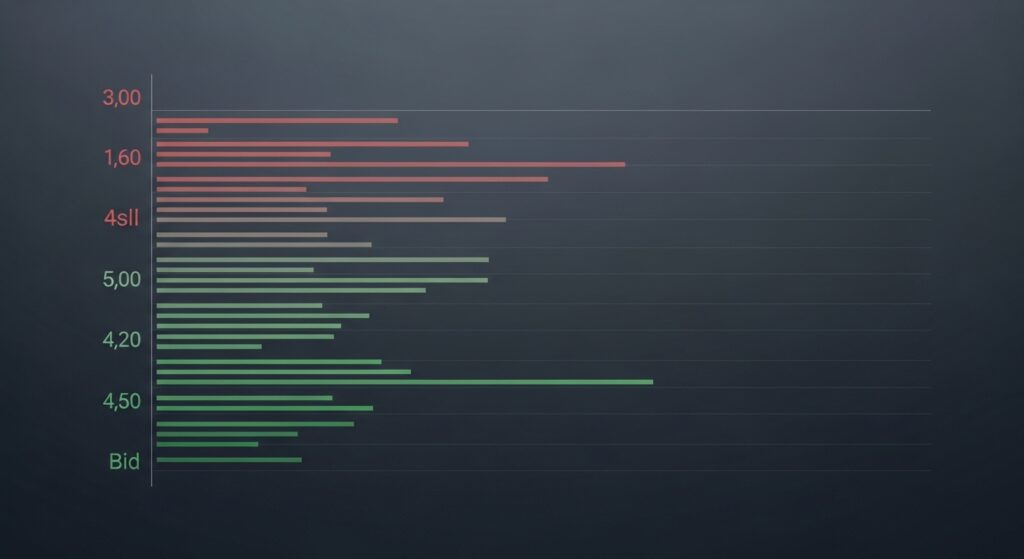
Market depth explains how much buying or selling pressure a market can absorb without causing large price changes. While price charts show where the market has been, order books reveal what may happen next — especially during volatile or low-liquidity conditions.
Understanding market depth helps investors interpret price movements more accurately in both stock and crypto markets.
What Is Market Depth?
Market depth refers to the volume of buy and sell orders at different price levels in an order book. It shows how many participants are willing to trade and at what prices.
A deep market typically features:
- Multiple layers of buy and sell orders
- Large order sizes near the current price
- Narrow bid-ask spreads
- Stable execution even for larger trades
A shallow market, by contrast, reacts sharply to relatively small orders.
How Order Books Reflect Supply and Demand
Order books visualize real-time supply and demand:
- Buy orders (bids) show where demand exists
- Sell orders (asks) show where supply is available
The balance between these levels determines how easily prices move. When demand overwhelms supply — or vice versa — prices adjust rapidly.
Why Market Depth Matters for Price Stability
Market depth directly influences:
- Price volatility
- Slippage
- Execution quality
- Risk management effectiveness
In shallow markets, prices can jump or drop sharply even without major news. In deep markets, similar trades have minimal impact.
Market Depth in Stocks vs Crypto
While the concept is universal, depth behaves differently across markets.
Stocks:
- Centralized exchanges
- Institutional market makers
- Generally deeper order books for large-cap names
Crypto:
- Fragmented liquidity across venues
- Higher retail participation
- Depth varies widely between assets
As a result, crypto markets often experience faster price swings when depth thins.
How Traders Use Market Depth
Traders analyze depth to:
- Identify support and resistance zones
- Anticipate potential breakouts
- Detect hidden liquidity or spoofing attempts
- Manage order size and execution timing
Market depth provides context that price charts alone cannot offer.
When Market Depth Breaks Down
Depth often deteriorates during:
- High volatility events
- Macroeconomic uncertainty
- Sudden sentiment shifts
- Liquidity withdrawals by market makers
When this happens, spreads widen and prices become more sensitive to order flow.
Limitations of Market Depth
Order books are dynamic and can change quickly. Not all displayed liquidity is genuine, and large participants may hide intentions through algorithms.
For this reason, market depth should be analyzed alongside volume, volatility, and broader market conditions.
Market Depth as a Core Market Mechanism
Market depth is a structural feature that determines how efficiently markets function. In both stocks and crypto, it plays a central role in shaping price behavior, volatility, and risk.
Understanding order books allows investors to better interpret market dynamics — especially during periods of stress or rapid movement.