Market sentiment reflects the overall emotional and psychological state of investors. While prices are often explained through fundamentals, sentiment plays a powerful role in how quickly markets move — especially in stocks and crypto, where perception can change faster than underlying data.
Understanding market sentiment helps investors interpret price behavior beyond headlines and technical signals.
What Is Market Sentiment?
Market sentiment describes whether investors are generally optimistic (bullish) or pessimistic (bearish) about future price direction.
Sentiment is not based on a single data point. Instead, it emerges from:
- Collective expectations
- Risk appetite
- Reactions to news and uncertainty
- Positioning and leverage
At extremes, sentiment can override fundamentals in the short term.
Fear and Greed as Market Drivers
Two core emotions dominate financial markets:
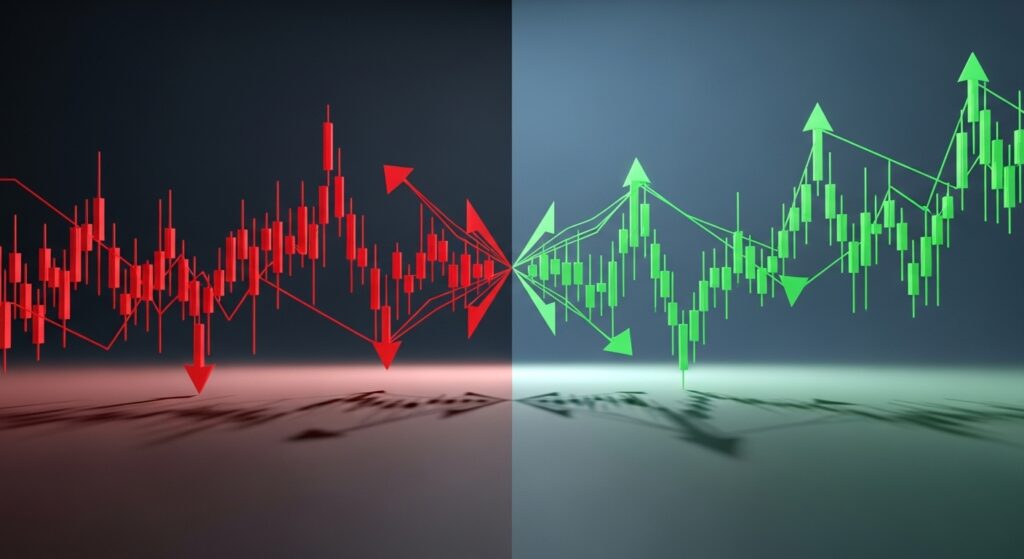
Greed During Expansions
When prices rise consistently, investors tend to:
- Increase exposure
- Use leverage more aggressively
- Ignore negative signals
- Chase momentum
This behavior often pushes prices beyond fair value, increasing vulnerability to corrections.
Fear During Pullbacks
During declines, fear leads to:
- Panic selling
- Rapid risk reduction
- Overreaction to negative headlines
- Liquidity evaporation
Fear-driven moves tend to accelerate declines before stabilization occurs.
How Market Sentiment Shifts
Sentiment can change quickly due to:
- Central bank signals
- Economic data surprises
- Earnings releases
- Regulatory announcements
- Geopolitical developments
- Sudden liquidity changes
In crypto markets, sentiment often reacts faster due to 24/7 trading and high retail participation.
Market Sentiment in Stocks vs Crypto
While sentiment affects all markets, its impact differs:
Stocks:
- Slower sentiment shifts
- Institutional investors dampen extremes
- Earnings and macro data provide anchors
Crypto:
- Faster emotional cycles
- Greater retail influence
- Higher sensitivity to narrative changes
As a result, sentiment-driven volatility is more pronounced in crypto assets.
Indicators Used to Measure Sentiment
Investors track sentiment through various indicators, including:
- Volatility indexes
- Put/call ratios
- Funding rates
- Open interest trends
- Fear & Greed-style composite indexes
- Social and news sentiment analysis
No single indicator is definitive. Sentiment works best when viewed in context.
Why Sentiment Matters for Investors
Ignoring sentiment can lead to poor timing decisions. Understanding it helps investors:
- Avoid buying into euphoric peaks
- Reduce panic during sell-offs
- Identify potential inflection points
- Align positioning with risk conditions
Sentiment does not replace fundamentals, but it often explains when prices move.
Using Sentiment Without Emotional Trading
Successful investors treat sentiment as information, not instruction. They observe emotional extremes while maintaining discipline through:
- Risk management
- Position sizing
- Long-term perspective
- Confirmation from data and structure
This approach reduces reactionary decisions driven by fear or greed.
Market Sentiment as a Cycle
Fear and greed are not anomalies — they are recurring features of financial markets. Recognizing where sentiment stands helps investors better understand price behavior in both stocks and crypto.
Markets may be driven by data, but they are moved by people.